Data Pipeline
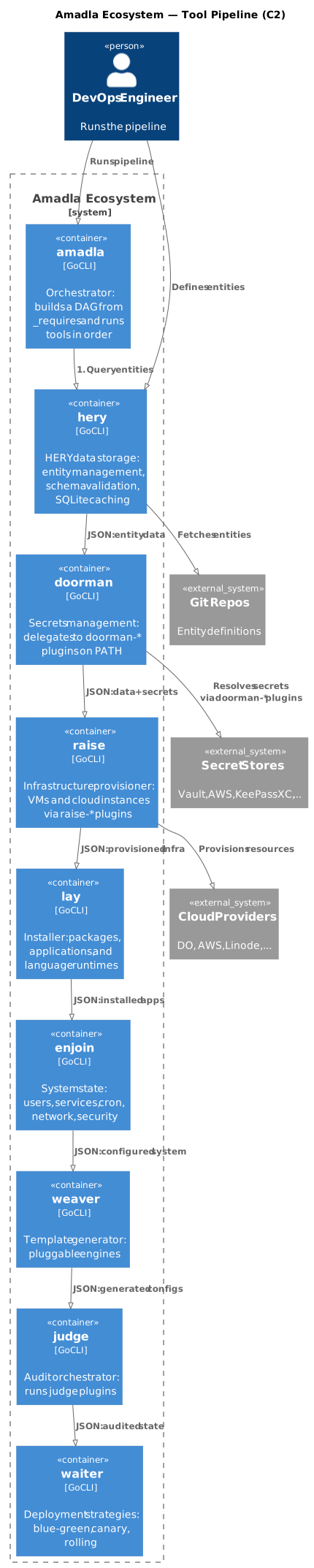
The Amadla pipeline transforms application requirements into running, audited infrastructure. Each tool handles one stage, reading structured entity data from upstream and emitting JSON for the next stage.
Pipeline Stages
Stage Details
1. hery — Source of Truth
Input: YAML entity files on disk (or in Git repos) Output: Structured entity data as JSON
hery reads .hery files that describe what an application needs. Each file is an entity — a versioned, schema-validated document with five reserved properties (_type, _extends, _meta, _body, _requires). Entity identity is derived from the git path (directory position in repo). The _requires property declares dependencies between entities — amadla builds a DAG and topologically sorts to determine execution order.
# Query all application entities
hery query --type '*/application@*'

# Get a specific entity
hery entity get "amadla.org/entity/application@v1.0.0"
Entities are cached in SQLite for fast querying. The source of truth remains the .hery files (optionally version-controlled via Git).
2. doorman — Resolve Secrets
Input: Entity data containing secret references Output: Entity data with secrets resolved to actual values
doorman discovers doorman-* plugins on PATH and routes secret requests to the appropriate backend (Vault, AWS, KeePassXC, etc.). Each plugin outputs secrets in a universal entity format.
# Resolve secrets in a pipeline
hery query --type '*/application@*' -o json | doorman resolve -o json

# List available secret backends
doorman list
3. raise — Provision Infrastructure
Input: Infrastructure entity requirements Output: Provisioned servers, networks, storage
raise reads infrastructure entity declarations and provisions the required resources. It wraps infrastructure-as-code tools via a plugin system for different providers. Available plugins: raise-libvirt (KVM/QEMU), raise-virtualbox, raise-wsl, raise-aws (EC2), raise-digitalocean, raise-quickemu, raise-opentofu (declarative IaC).
4. lay — Install Applications
Input: Application and system entity requirements Output: Installed packages, applications, JARs, container images (outputs image ref entity)
lay installs required software: packages via system package managers, applications, JAR files, and container image pull/build. For containers, lay handles build and pull — waiter handles the rest.
# Install packages
lay install

# Pull container image, pipe to waiter for deployment
lay pull my-app:v2 | waiter deploy --strategy canary
5. enjoin — Configure System State
Input: System state entity requirements (User, Service, Cron, System/, Security/) Output: Applied system state on the target machine
enjoin applies system state configuration — users, services, cron jobs, and System/ and Security/ settings — by routing each entity to the matching enjoin-* plugin.
6. weaver — Generate Configuration
Input: Templates + entity data (with resolved secrets), via UNIX piping or direct cache queries Output: Rendered configuration files (Quadlet, nginx.conf, podman-compose, k8s, GitHub Actions, or any text file)
weaver takes template files and fills them with data from HERY entities. It supports multiple template engines via Weaver plugins (Jinja, Mustache, Handlebars, Qute).
# Render templates — weaver discovers template entities from hery automatically
hery query --type '*/application@*' -o json | doorman resolve -o json | weaver render

# Template entities define which engine to use and where templates live
# No --template flag needed — it's all in the entity data
weaver is an ETL-like tool — it can generate any text output. Config generation is weaver's job (including Quadlet unit files, nginx configs, CI/CD pipelines, etc.).
7. waiter — Deploy
Input: Entities + rendered config files (from weaver) Output: Deployed application with traffic management
waiter handles the deployment lifecycle using strategies (blue-green, canary, rolling). It consumes container image refs from lay and rendered configs from weaver.
# Full deployment pipeline
hery query --type '*/application@*' | doorman resolve | weaver render | waiter deploy --strategy canary

# Promote canary to full traffic
waiter promote my-app

# Rollback
waiter rollback my-app
8. judge — Validate
Input: Expected state (from hery) + actual state (from unravel) Output: Judge entity (diff — pass/fail per requirement)
judge compares "what IS" (via unravel) vs "what SHOULD BE" (via hery entities) and outputs a judge entity — a diff in entity format. Supports both generic deep diff and type-aware judge plugins.
# Drift detection
unravel discover --type network | judge audit

# Reconciliation loop (on cron/systemd timer)
unravel discover | judge audit | lighthouse notify
Supporting Tools
| Tool | Role |
|---|---|
| unravel | Discovers existing system state as entities. Wraps osquery (on-demand, stateless) + custom plugins |
| conduct | Multi-server orchestration — coordinates waiter/lay across distributed nodes |
| lighthouse | Notifications/alerts via plugins (webhook, SMS, email, REST API). Receives entity output from any tool |
| dryrun | Safely tests settings by applying them and auto-reverting if something goes wrong |
| garbage | Tracks what's no longer needed and handles cleanup/uninstallation |
| amadla | Orchestrator — reads .hery entities, builds DAG from _requires, executes tools in parallel tiers |
Data Flow Example
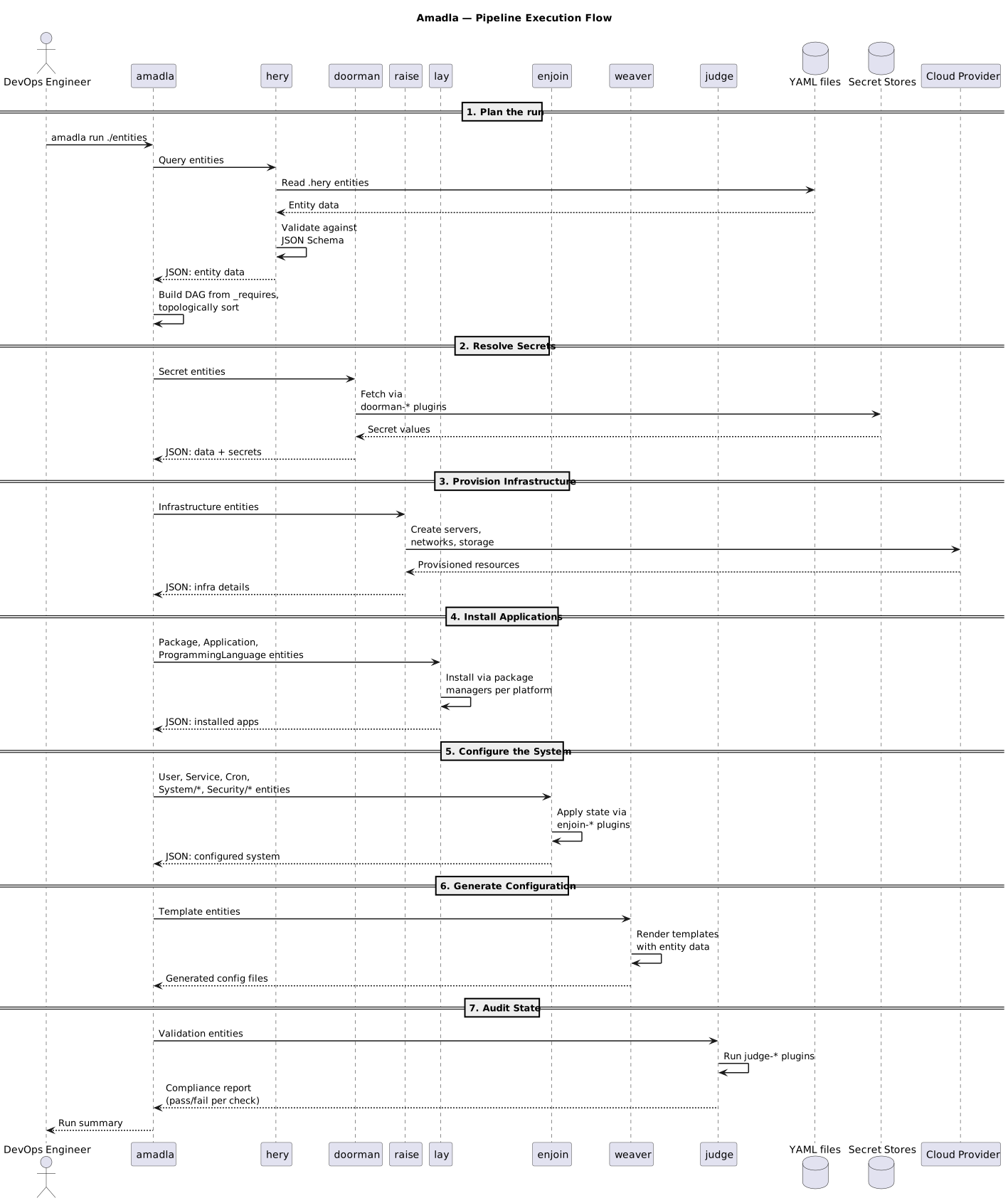
The following sequence diagram shows the full pipeline execution:
A complete flow for deploying a containerized web application:
# yaml-language-server: $schema=https://amadla.org/entity/hery/v1.0.0/schema.hery.json
---
_type: amadla.org/entity/application/webserver@v1.0.0
_meta:
  name: my-web-app
  description: Web application with TLS
_body:
  name: my-web-app
  port: 443
  network:
    ports:
      - 80
      - 443
# Pipeline execution
hery query --type '*/application@*' -o json \
  | doorman resolve -o json \
  | weaver render -o json \
  | waiter deploy --strategy canary --weight 5

# Validate
unravel discover | judge audit

# Promote if OK
waiter promote my-app
Each | represents a JSON entity hand-off between tools.