Vision & Philosophy
The Problem: Configuration is Far from the Resource
Traditional IaC tools (Terraform, Ansible, Puppet) are environment-centric: settings live near the environment, not near the resource. A developer deploying an application must hunt through documentation, do trial and error, and hope they don't forget a critical requirement. When something fails, generic errors from Linux or cloud providers give little indication of what's actually missing.
Requirements are often given in documentation format — or not at all. The knowledge of "what does this application need to run?" is scattered across READMEs, wiki pages, and tribal knowledge.
The Solution: Application-Centric Configuration
Amadla inverts this. It is application-centric: each application — along with its services, databases, and other components — carries its own configuration as a schema-validated HERY entity. Requirements are declared explicitly — not buried in docs — and enforced by schemas.
Example
Environment-centric (Ansible):
- hosts: webservers
  tasks:
    - apt: name=nginx state=present
    - template: src=nginx.conf.j2 dest=/etc/nginx/nginx.conf
    - service: name=nginx state=started
You must know that this app needs nginx, where the config goes, and how to start it. This knowledge is baked into the playbook. Forget a requirement? You'll find out at deploy time.
Application-centric (Amadla):
# yaml-language-server: $schema=https://amadla.org/entity/hery/v1.0.0/schema.hery.json
---
_type: amadla.org/entity/application@v1.0.0
_requires:
  - amadla.org/entity/application/db/rdbms@^v1.0.0
_meta:
  name: my-web-app
_body:
  name: my-web-app
  port: 80
The application declares its own requirements and dependencies. The schema enforces them. _requires declares what must be processed first — amadla builds a dependency graph (DAG) and topologically sorts execution order. Tools downstream (raise, lay, enjoin, weaver, waiter, judge) read these declarations and act accordingly.
Layered Composition
Resources don't exist in isolation. A system has multiple applications, each with its own HERY configuration. The OS has its own. The cloud service has its own. HERY merges them — think of it as layers:
Cloud/Infra layer    ← Infrastructure (AWS, DigitalOcean, bare metal...)
  └─ OS layer        ← System (Ubuntu, NixOS...)
    └─ App layer     ← Application (nginx, postgres...)
      └─ Override    ← User's site-specific HERY
Each layer can override or extend the layers below it. The directory path determines whether a value is overridden (same path = deep merge) or added (different path = accumulate). The merged result is the source of truth, but every individual layer is preserved and queryable.
UNIX Philosophy
Amadla follows the UNIX philosophy:
-
Each tool does one thing well.
herymanages data,doormanmanages secrets,weavergenerates templates,waiterdeploys,judgevalidates — they don't overlap. -
Tools communicate via standard I/O. Data flows through stdin/stdout as JSON or YAML. Diagnostics go to stderr. No shared databases, no message queues, no RPC — just pipes.
-
Small, composable programs. You can use any tool independently, or chain them together in a pipeline.
-
Text (structured data) as the universal interface. YAML in, JSON out. Every tool speaks the same entity format.
-
No caching by default. Tools like unravel discover and output — the user caches if they want. Data flows through pipes, not shared state.
The Pipeline Model
The Amadla pipeline flows from requirements to running infrastructure:
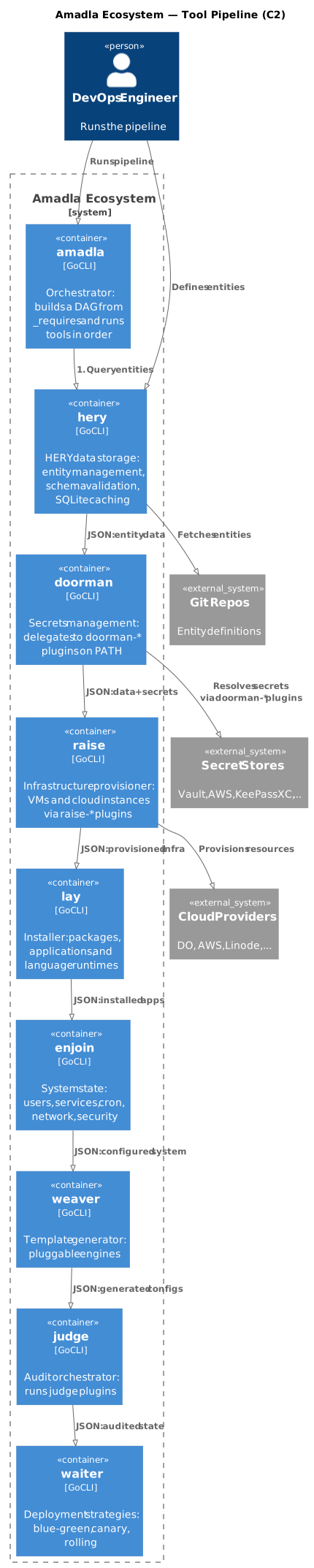
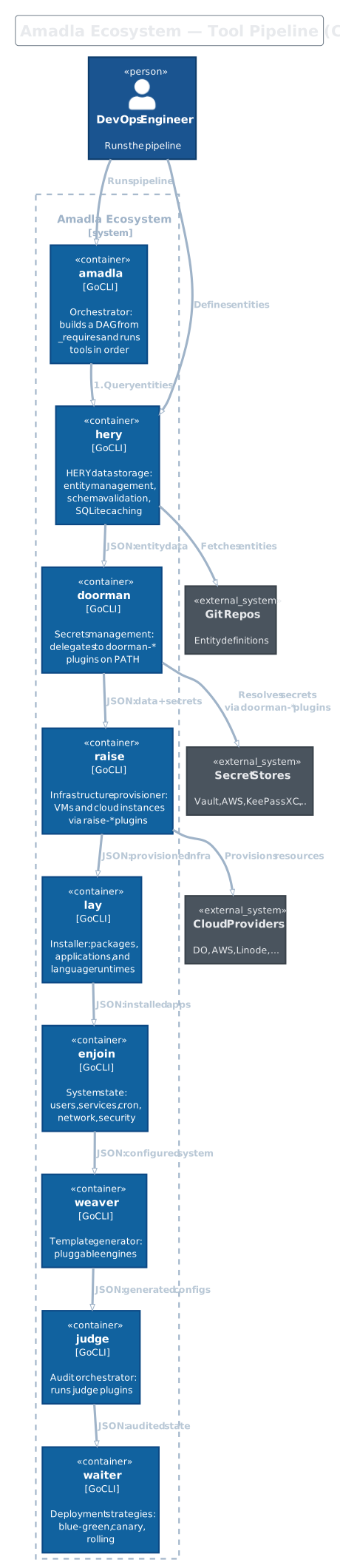
| Stage | Tool | Input | Output |
|---|---|---|---|
| Define | hery | .hery entity files |
Merged entity JSON |
| Resolve secrets | doorman | Entity data with secret refs | Entity data with resolved secrets |
| Provision | raise | Infrastructure entities | Provisioned servers/resources |
| Install | lay | Application entities | Installed software + image ref entity |
| Configure | enjoin | System state entities (User, Service, Cron, System/, Security/) | Applied system state |
| Generate config | weaver | Templates + entity data | Config files (Quadlet, nginx.conf, etc.) |
| Deploy | waiter | Entities + configs | Deployed application |
| Validate | judge | Expected + actual entities | Judge entity (diff) |
Supporting Tools
| Tool | Role |
|---|---|
| unravel | Discovers existing system state as entities (wraps osquery, stateless) |
| conduct | Multi-server orchestration (coordinates waiter/lay across nodes) |
| lighthouse | Notifications/alerts via plugins (webhook, Slack, email, SMS, WebRTC) |
| dryrun | Safely tests settings with auto-revert (prevents SSH lockout, etc.) |
| garbage | Tracks and removes what's no longer needed |
| amadla | Orchestrator: reads .hery entities, builds DAG from _requires, executes tools in parallel tiers |
Encouraged Infrastructure
- Podman (rootless, Quadlet) — single-server container management via systemd
- HAProxy — load balancing and traffic management
- systemd — restarts failed containers on a single server
- conduct — coordinates across servers when scaling beyond one
Extensibility Through Plugins
Each tool that interfaces with external systems uses a plugin architecture:
- doorman-* plugins extend doorman with new secret sources (Vault, AWS, KeePassXC, Keycloak, ...)
- judge-* plugins extend judge with new validation targets (applications, systems, infrastructure)
- weaver-* plugins extend weaver with new template engines (Go, Jinja2, Mustache, Qute, FreeMarker)
- raise-* plugins extend raise with VM and cloud providers (libvirt, VirtualBox, WSL, QuickEmu, AWS, DigitalOcean, OpenTofu)
- waiter-* plugins extend waiter with deployment backends (Podman, Docker, Quadlet) and proxy backends (HAProxy, Kamal Proxy)
- lighthouse-* plugins extend lighthouse with notification channels (webhook, Slack, email, SMS, WebRTC)
- unravel-* plugins extend unravel with custom discovery backends
Plugins are standalone CLI executables discovered via $PATH using a <tool>-* naming convention (e.g., doorman-vault, judge-application, weaver-jinja2). They communicate via stdin/stdout/stderr following a standard protocol — no IPC, no daemons. Plugins can be written in any language. Go framework libraries are available as optional convenience wrappers to reduce boilerplate.
The amadla Orchestrator
The amadla CLI is the top-level orchestrator. It reads .hery entity files from a directory, builds a dependency graph (DAG) from _requires declarations, topologically sorts them, and executes the registered tool for each entity type. Independent entities within the same DAG tier run in parallel.
amadla uses a config-driven model for tool discovery (~/.config/amadla/tools.hery), with <tool> info cached discovery for automatic capability detection. The amadla init command bootstraps this config by scanning PATH for standard Amadla tool names.
amadla is written in Go but is replaceable — the entities and tools are the portable parts. Anyone can read .hery files, resolve the DAG, and orchestrate the tools their own way.